

What spinning actually does
After cleaning and combing, cotton exists as a loose rope of parallel fibres called a sliver. It has no strength — pull it and it comes apart in your hands.
Spinning is the step that turns that rope into thread, by drawing it thinner and twisting it so the fibres grip each other. Everything about the resulting yarn — its smoothness, its strength, how hairy it is — comes out of how that twist was introduced.
Ring spinning: slower, finer, smoother
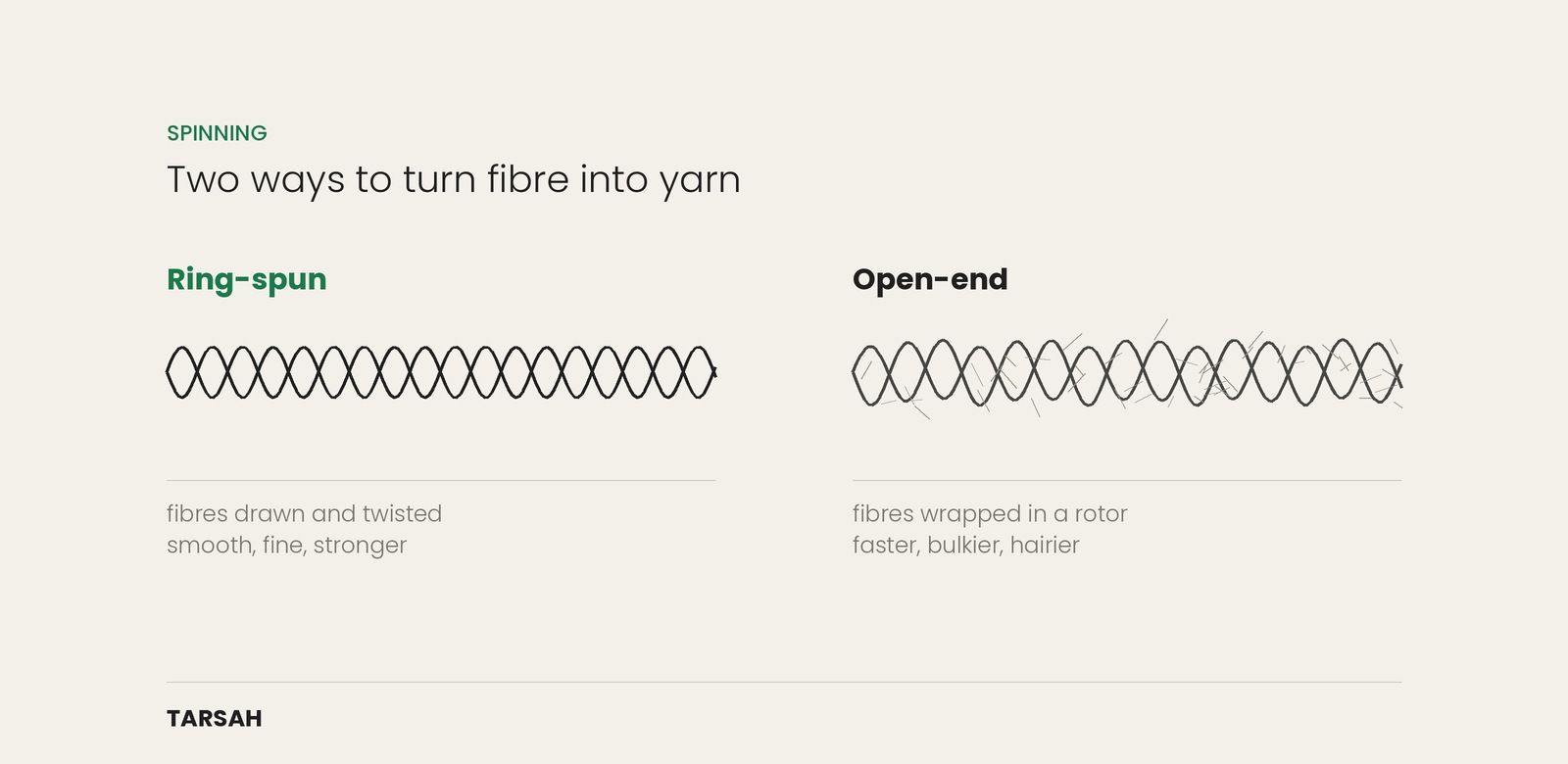
Ring spinning draws the sliver out gradually and twists it continuously as it winds onto a bobbin. The fibres end up lying roughly parallel along the length of the yarn, wrapped into a tight, even helix.
That alignment is what you feel. Ring-spun yarn is smoother against skin, finer at the same strength, and less prone to shedding loose ends. It is also slow to produce, which is the entire catch.
Open-end spinning: faster, bulkier, hairier
Open-end spinning — also called rotor spinning — breaks the sliver into individual fibres, feeds them into a fast-spinning rotor, and lets them collect at the open end of the forming yarn.
It is dramatically quicker and cheaper. But fibres get caught around the outside rather than lying along the length, so the yarn ends up bulkier, less even along its axis, weaker for its thickness, and noticeably hairier.
Most inexpensive T-shirts are open-end. It is not a scandal. It is a price decision that you feel on the third wash rather than in the shop.
How to tell them apart
Neither is labelled reliably, so use your hands and a window.
- Hold it to the light. Open-end yarn shows more fuzz standing off the surface, and the fabric looks slightly cloudier.
- Run a palm across it. Ring-spun reads slick and cool. Open-end catches faintly on dry skin.
- Look for thickness variation. Open-end yarn is more even in diameter but less even in surface. Ring-spun is the reverse.
- Check the drape. At the same GSM, ring-spun falls softer, because the yarn is finer for the same strength.
The practical shortcut: if a brand spent the money on ring-spinning, it almost always says so.
Where it fits with everything else
Spinning is the third variable in a chain, and each one is independent.
Fibre length decides what you have to work with. Combing decides which fibres survive. Spinning decides how they are held together. Knit structure and GSM decide what the fabric does with the resulting yarn.
Change any one and you get a different shirt. Which is why a single number on a label has never been enough to judge one.
Ask about the yarn, not just the cotton
"100% cotton" describes the raw material and nothing about the craft applied to it. The interesting question is what happened between the field and the fabric.