

The rule is "last substantial transformation"
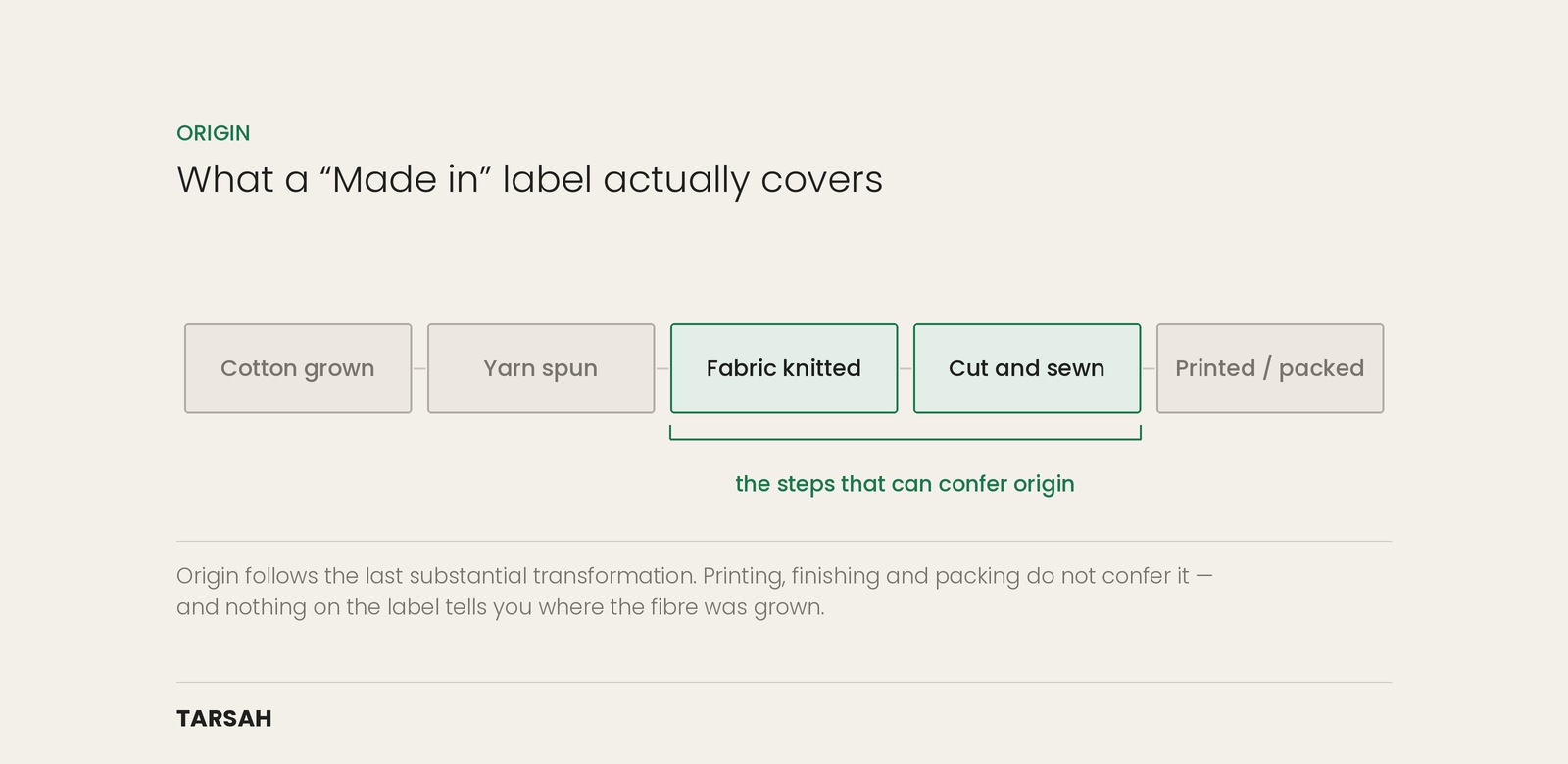
Origin is assigned to the country where the last substantial processing took place — the step that meaningfully changes what the thing is.
Knitting yarn into fabric counts. Cutting and sewing that fabric into a garment counts. Printing a logo on a finished shirt does not. Neither does dyeing alone, or folding and bagging it.
So a plain tee knitted and sewn in one country, then printed in another, keeps the first country on its label. The printing is real work, but it is not transformation.
What the label leaves out
Everything upstream of that final step is invisible.
The cotton can be grown on one continent, ginned on another, spun somewhere else again, and none of it appears. A garment can carry a European origin label with fibre that has never been within three thousand kilometres of Europe.
This is not a loophole being exploited so much as the honest limit of a two-word label. It was never designed to describe a supply chain.
Why brands say "made in" rather than "grown in"
Because "made in" is the claim they can actually stand behind.
Some fibre origin claims carry legal weight and certification schemes behind them, and using that language without the paperwork is a real risk. A brand that says where a garment was assembled and stops there is usually being careful rather than evasive.
The reverse is also worth noticing. Vague geography — "designed in", "crafted in the tradition of", a flag with no sentence attached — is doing decorative work, not informational work.
What to ask instead
If origin matters to you, the label is a starting point rather than an answer.
- Where was it assembled? This is what the label already tells you.
- Where was the fabric knitted? Often the same place, but not always.
- Where did the fibre come from? Rarely published. Ask.
- Who are the manufacturing partners? Named or at least described.
- Is the brand telling you, or letting you assume? The gap between those two is the whole subject.
A brand that cannot answer the middle three is not necessarily hiding anything. But it does mean the label is carrying more meaning than it can hold.
Where Tarsah lands
Everything we make is 100% cotton, made in Egypt. We work with mid-sized Egyptian factories, and the cotton is grown and processed there too — which is the specific reason we can use that phrase without stretching it.
We say "made in Egypt" rather than reaching for grander cotton language, because the first is a plain fact about where the work happened and the second is a claim with certification attached to it. We would rather be exact than impressive.
Read the label as one fact, not a story
Two words on a seam tag can tell you where a garment was assembled. That is genuinely useful, and it is all it is.
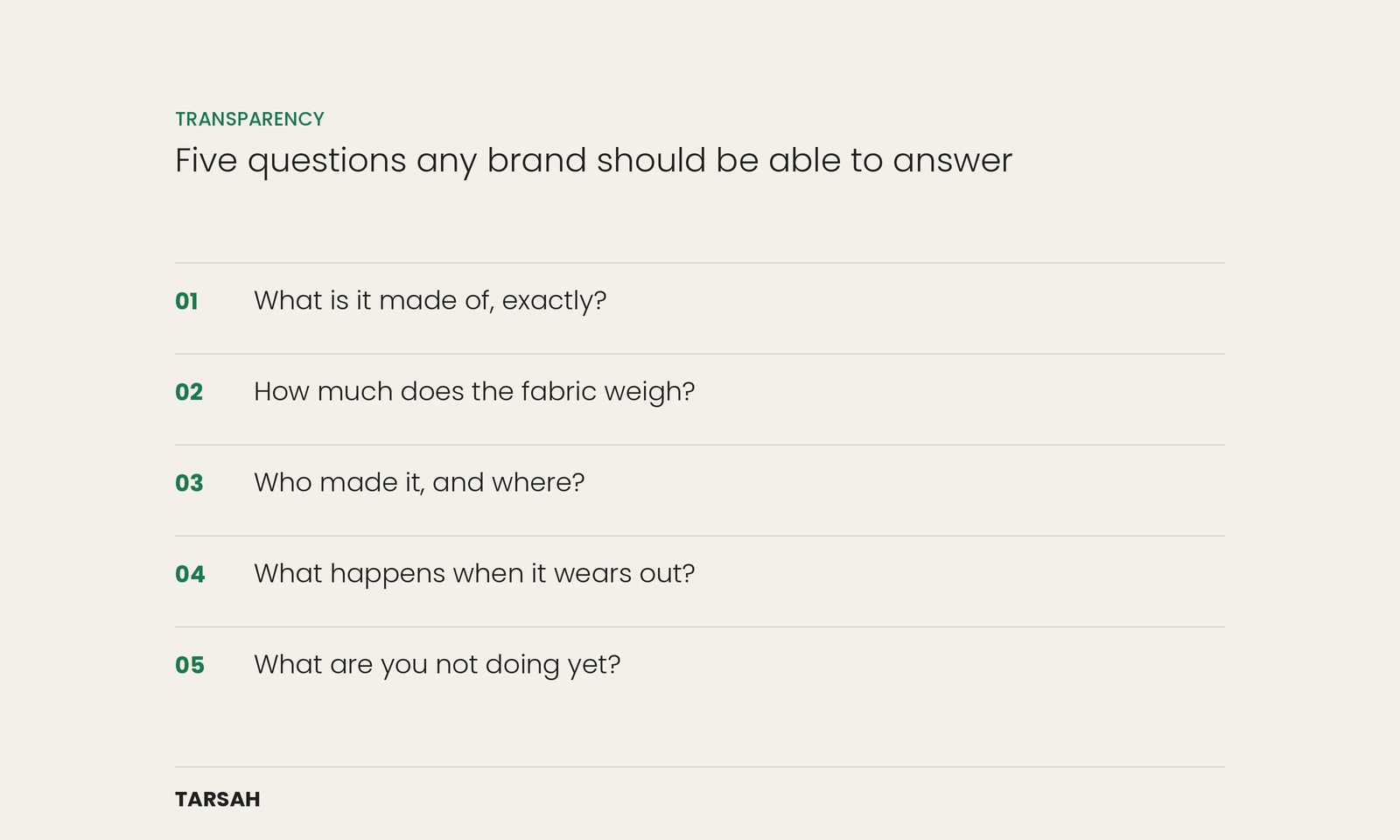
The rest of the questions still need asking — here are five worth starting with.