

Most of it never gets collected at all
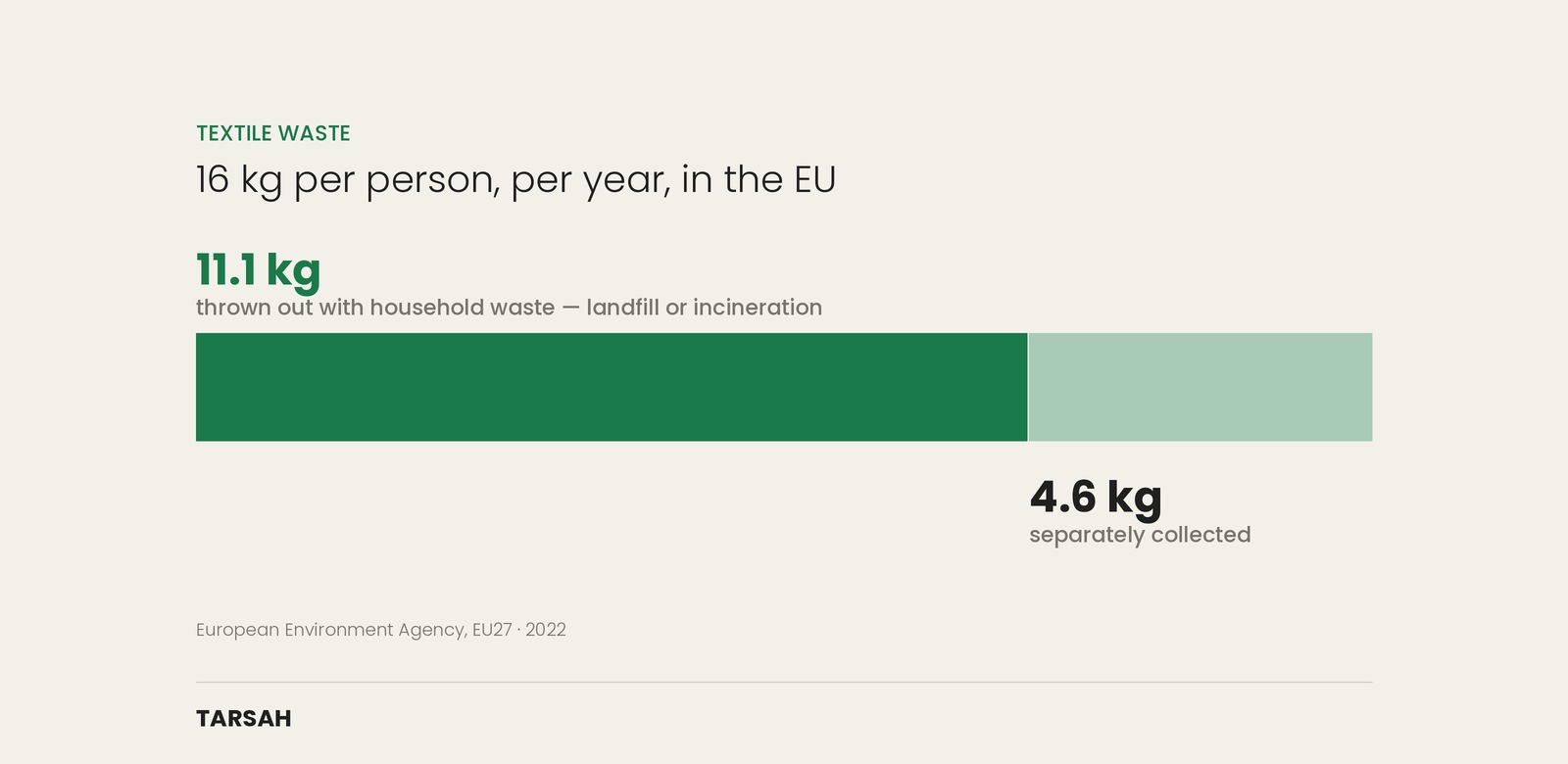
The EU generated about 16 kilograms of textile waste per person in 2022 — roughly 6.9 million tonnes across the bloc, a figure that has barely moved since 2016.
Of that 16 kg, only 4.6 kg was separately collected. The other 11.1 kg went out with ordinary household rubbish, which means landfill or incineration. More than twice as much clothing is thrown away as is handed in.
So before any question about recycling, there is a blunter one: most garments never reach a system that could do anything with them.
Collected does not mean recycled
What does get collected largely leaves. The EU exported almost 1.7 million tonnes of used textiles in 2019, up from a little over 550,000 tonnes in 2000 — roughly a tripling in twenty years.
About 46 per cent went to Africa and 41 per cent to Asia. Very little of it is recycled in the sense most people mean: taken apart and spun into new yarn.
What happens at the other end
The two destinations do different things with it.
- In Africa, there is genuine demand for cheap second-hand clothing, and much of it is worn again. What is unsellable — stained, torn, or simply too poor quality — ends up in open landfill and informal waste streams.
- In Asia, shipments are sorted and processed. Most are downcycled into industrial rags and stuffing, or re-exported onward. What cannot be used goes to landfill.
Reuse is the good outcome here, and it is real. But it depends entirely on the garment being good enough that somebody else wants it.
Blends are the reason recycling stalls
Fibre-to-fibre recycling works best on a single material. A shirt that is 60 per cent cotton and 40 per cent polyester is two materials chemically bonded at the yarn, and separating them at scale is still not economic.
That is why most textile 'recycling' is downcycling — the fabric becomes a rag or a filling, one step down, once. A single-fibre garment is not automatically recycled, but it is at least a candidate.
Where Tarsah lands
We make single-fibre garments — 100% cotton, made in Egypt, no synthetic blend — which keeps them a candidate for reuse and recycling rather than a mixed-material problem. We also restock only what sells, so we are not producing inventory that goes straight to the same pile.
But the honest version is this: no end-of-life system beats not needing one. The most sustainable shirt on this page is the one still in your rotation in year five.
The useful thing you can do
Wear it longer, and when you do let it go, hand in things that are still genuinely wearable — the reuse chain only works on clothes someone else would choose.
It is the same arithmetic as cost per wear, viewed from the other end.