

It is mostly tension, not the fibre
Knitting pulls yarn tight. Every loop in a jersey fabric is held under tension through knitting, dyeing and finishing, and the finished roll leaves the mill stretched slightly longer than it wants to be.
Then you add water. The fibres swell, the loops relax, and the fabric contracts back toward the shape it would have taken all along. That is relaxation shrinkage, and it is the bulk of what you see.
The numbers, roughly
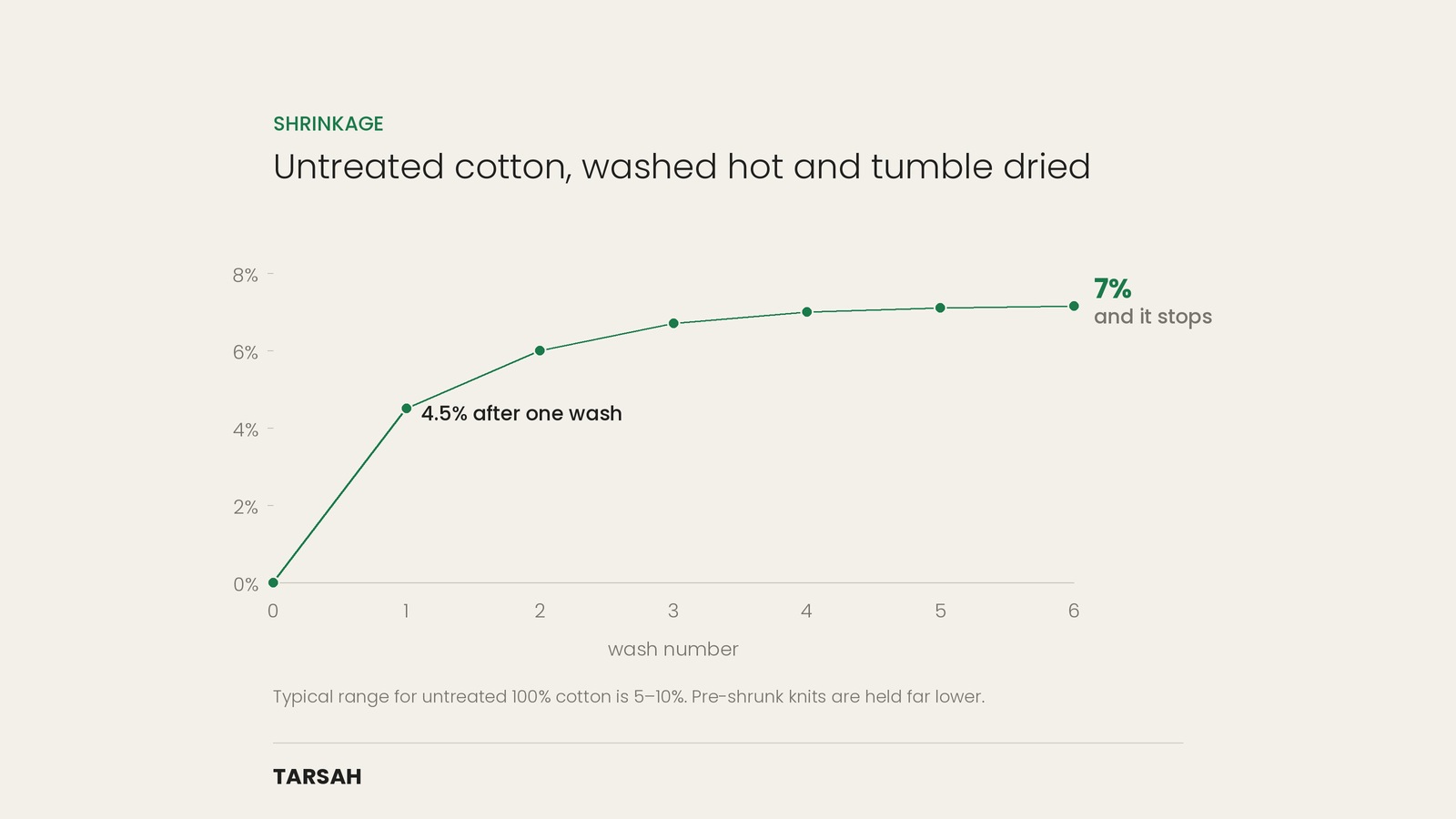
Untreated 100 per cent cotton typically loses somewhere between 5 and 10 per cent of its length on a hot wash. Most of that arrives immediately — something like 70 to 90 per cent of a garment's total lifetime shrinkage happens in the first one to three washes, and it has usually plateaued by about the fifth.
Which is the good news buried in this. A cotton shirt shrinks once, early, and then stops. It does not keep shrinking forever.
Pre-shrinking moves the problem before you buy
Mills can put the fabric through the relaxation before the garment is cut — compacting or sanforizing it, essentially shrinking it on purpose under controlled conditions.
The Sanforized specification holds residual shrinkage to 1 per cent on wovens and up to 5 per cent on knits. It is not zero. But it is the difference between a shirt that fits differently after one wash and one that fits the same for years.
What you can actually control
Heat and agitation do the damage, and the dryer does more of it than the washer.
- Wash cool. 30°C or below. Hot water drives water into the fibre faster and relaxes more loops.
- Skip the tumble dryer. High heat drying adds roughly one to two percentage points on top of the wash, and it is the single biggest lever you have.
- Dry flat or on a hanger. Let gravity hold the length rather than a hot drum beating it out.
- Do not over-dry. Fibres locked dry in a relaxed state stay that way.
None of this stops relaxation shrinkage completely. It just stops you from adding to it.
Where Tarsah lands
We work in 100 per cent cotton with no elastane, so nothing in the garment is fighting the fibre in the opposite direction.
And since a cotton tee does most of its moving in the first few washes, the honest advice is the unglamorous one: wash it cool, hang it to dry, and judge the fit at wash three rather than wash one.
Buy for the size it will settle at
If a shirt fits perfectly tight in the shop and the label says untreated cotton, it will not fit next week. Check the composition and the care label before the mirror.