

Most of the world's clothing is plastic now
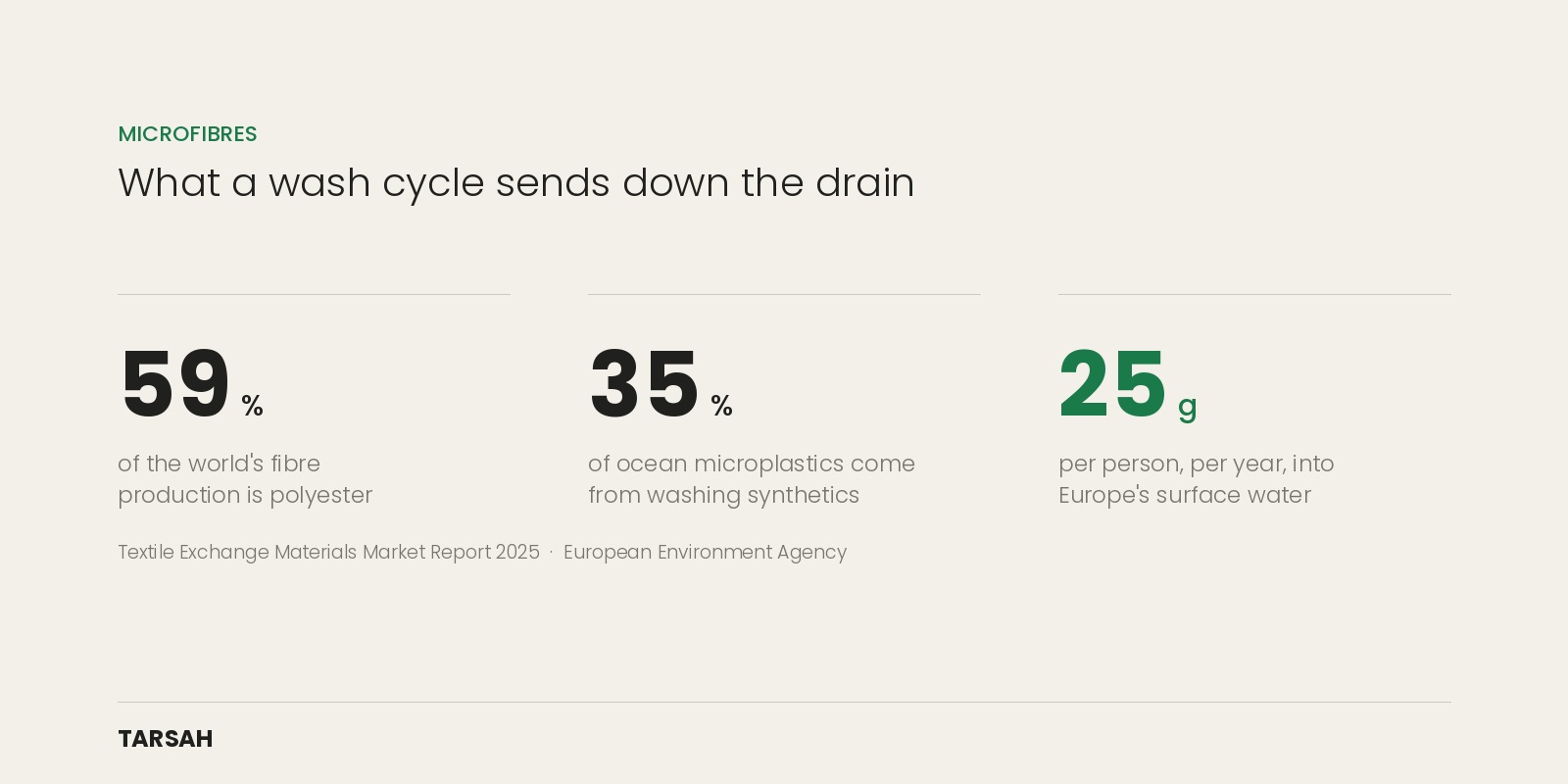
Global fibre production hit 132 million tonnes in 2024. Polyester accounted for 59 per cent of it — around 78 million tonnes — and its share is still climbing. Cotton came to 19 per cent.
Polyester is plastic. So is nylon, so is acrylic, so is the elastane blended into almost everything stretchy. When one of those sheds a fibre in your washing machine, what leaves the drum is a strand of plastic a few micrometres across.
What ends up in the water
The European Environment Agency estimates that roughly 13,000 tonnes of textile microfibres reach Europe's surface water each year — about 25 grams per person. Globally, washing synthetic textiles is thought to account for something like a third of the microplastics entering the oceans.
These are estimates with wide error bars, and anyone quoting them to the decimal place is overselling. The direction of travel is not really in dispute, though.
The first few washes do most of the damage
Shedding is front-loaded: a new synthetic garment gives up most of its loose fibre in its first handful of cycles, then settles down.
A few things measurably change how much comes off:
- Top-loading machines shed considerably more than front-loaders.
- Hot, long cycles shed more than cool, short ones.
- Powder detergent sheds more than liquid.
- Fabric softener actually reduces shedding.
None of that fixes the problem. It just moves the number.
Cotton is not nothing — but it is different
Natural fibres shed too. A cotton shirt loses fibre in the wash exactly like a polyester one does, and those fibres also end up in the water.
The difference is what happens next. Cotton is cellulose, and cellulose breaks down. Polyester does not — it fragments, and keeps fragmenting. Dyes and finishes still matter either way, so this is a real difference rather than a clean conscience.
Where Tarsah lands
We make our tees from 100 per cent cotton, with no synthetic blend. Not because a cotton shirt is harmless, but because the simplest way to not shed plastic is to not have any in the garment.
It is also the least glamorous kind of decision a brand can make. Nobody notices the polyester that is not there.
Check the composition label
Whatever you buy, and wherever you buy it, the fibre content is printed inside the collar. It is the single most informative line on the garment.